
How are gemstones valued?
Colour, clarity, cut and carat weight, and what else moves the price: treatments, origin, rarity, phenomena and laboratory reports.
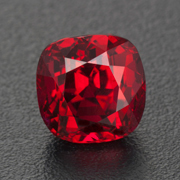
There is no official price list for gemstones. Two stones of the same gem and the same weight can differ in price a hundredfold. Value comes from what the stone is, how fine an example it is, how rare that is, and how much people want it. This article explains the factors dealers, appraisers and laboratories look at. It does not give prices: those change with the market and vary enormously between individual stones.
First, what is it?
Everything starts with identity. A red stone could be ruby, spinel, garnet, tourmaline, glass or synthetic ruby, and the difference in value between them is far larger than any difference in quality. So the first questions are always: which species and variety, is it natural or synthetic, and has it been treated? See How are gemstones identified?
The four Cs
For diamonds, the trade grades four qualities, the "four Cs": colour, clarity, cut and carat weight. Laboratories grade colourless diamonds on a scale from D (colourless) to Z (light yellow or brown) and clarity from Flawless to Included. Coloured gemstones are judged on the same four qualities, but without a single universal grading scale, and their relative importance is different.
Colour
For coloured stones, colour usually matters most. It is described by three components:
- Hue, the basic colour (red, slightly purplish red, orangy red ...). The most valued hues are often close to pure spectral colours.
- Tone, how light or dark the stone is. Medium to medium-dark tones are usually preferred; too light looks washed out, too dark looks black.
- Saturation, the strength or purity of the colour, from greyish or brownish to vivid. Higher saturation is almost always more valuable.
Even colour across the stone matters too, as does how it looks in different lights. Gemdat's colour search uses a colour chart of hues and shades, and every graded photo is recorded with its colour.
Clarity
Clarity describes inclusions (crystals, fluids, fractures and growth features inside the stone) and blemishes on its surface. Fewer and less visible inclusions generally mean a higher value, but expectations depend on the gem. Aquamarine and topaz are usually found nearly free of visible inclusions, so included stones are discounted heavily. Emerald almost always contains inclusions, and an eye-clean emerald is exceptional. Inclusions also matter when they threaten durability, for example a fracture that reaches the surface.
Inclusions are not all bad: some create valued effects (the "silk" that softens a sapphire's colour, or the needles that give a star or a cat's eye), and many are the fingerprints that reveal a gem's identity, origin and treatment.
Cut
A good cut shows off the material: even, lively brilliance, few dark areas ("extinction") or see-through "windows", good symmetry and polish, and proportions that are neither too deep nor too shallow. Coloured stones are often cut to keep as much weight as possible from the rough, which can leave them lumpy or windowed; such stones are worth less per carat than well-cut ones. The shape and style also follow fashion. See Gemstone cuts.
Carat weight
Gems are weighed in carats: one carat is 0.2 grams. Larger stones are rarer, so the price per carat usually rises with size, and it jumps at round numbers that buyers look for, such as 1, 2 and 5 carats. Because gems differ in density, the same weight can mean a different size: a one-carat ruby (SG about 4.0) is visibly smaller than a one-carat emerald (SG about 2.7). Each gem page shows the range of sizes in which that gem has been photographed, a useful guide to how rare large stones are.
Treatments
Most gems on the market have been treated in some way, and treatment affects value strongly:
- Untreated stones of fine quality command a premium. Unheated ruby and sapphire, for example, sell for considerably more than comparable heated stones.
- Stable, widely accepted treatments such as heating ruby and sapphire or heating tanzanite have a moderate effect.
- Treatments that are less stable or create an appearance the stone never had, such as glass filling in ruby, beryllium diffusion, coating or dyeing, reduce value greatly.
Treatments must be disclosed. See Gemstone treatments for what each one involves and how it is detected.
Origin
For a few gems, the place they came from changes the price: sapphire from Kashmir, ruby from Myanmar (Burma) and emerald from Colombia are the best-known examples, and Paraíba tourmaline takes its name from a Brazilian state. Origin cannot be seen by eye. Laboratories estimate it from inclusions, trace-element chemistry and spectra, and not every stone can be assigned an origin. Ethical and traceable sources are also increasingly important to buyers.
Rarity, demand and phenomena
Rarity alone does not make a gem expensive: some very rare minerals are known only to collectors, while popular gems in strong demand can command high prices even though they are not especially rare. Optical phenomena add value when they are strong and well centred: the star in star sapphire, the eye in cat's-eye chrysoberyl, the colour change of alexandrite, the play of colour in opal and the sheen of moonstone.
Synthetics and simulants
Laboratory-grown gems are usually worth a small fraction of comparable natural stones, though fine large synthetics are not cheap to produce. Simulants such as glass are valued only as the material they are. Correct identification protects both buyer and seller.
Laboratory reports and appraisals
For valuable stones, buyers expect a report from an independent gemmological laboratory stating the identity, whether the stone is natural, any treatments detected, and sometimes its origin and quality grades. A report describes the stone; an appraisal or valuation puts a money figure on it for a particular purpose. Insurance replacement values, for example, are usually higher than what a stone would fetch if sold.
Practical points
- Buy from sellers who disclose treatments and accept returns if a laboratory disagrees with their description.
- Ask for a laboratory report for any important stone, and check that the report matches the stone (weight, measurements, photo).
- Keep a record: a gemdatID gives an individual gem a permanent identity with its photos, measurements, certificates and history.